Industry news
Key Factors Affecting Graphite Anode Performance
Graphite anode is the core negative electrode material for lithium-ion batteries, and its performance directly determines the energy density, cycle life, rate capability, and safety of the entire battery. For Lithium battery manufacturers, raw material selection and quality control of graphite anodes are the foundation of stable product performance. Below are the core factors that affect graphite anode performance, which are also the key points that global battery R&D and procurement teams focus on.
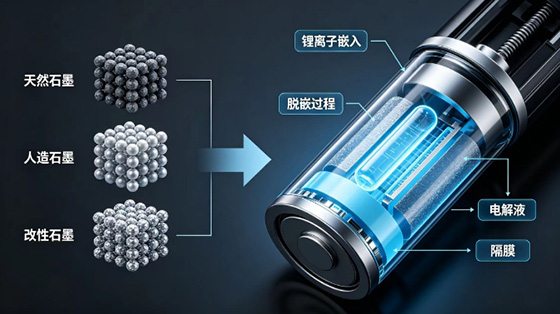
1. Graphite Type & Crystal Structure
The crystal structure of graphite is the fundamental factor determining its electrochemical performance, and different types of graphite have completely different application scenarios:
- Natural Graphite: High theoretical specific capacity (~372 mAh/g), low cost, but poor cycle stability and rate performance due to impurities and structural defects. Mainly used in low-cost energy storage batteries and consumer electronics.
- Artificial Graphite: High graphitization degree, stable crystal structure, excellent cycle life and rate performance, low expansion rate. It is the mainstream choice for power batteries (EVs) and high-end energy storage systems, and is also the core product of AOAO's anode material line.
- Modified Graphite (e.g., Silicon-Carbon Composite): By doping silicon or other materials, the specific capacity is greatly improved, but the volume expansion problem needs to be solved. It is the development direction of high-energy-density power batteries.
The degree of graphitization directly affects lithium ion intercalation/deintercalation efficiency: higher graphitization means more ordered layered structure, faster lithium ion transmission, and better rate performance, but too high graphitization will reduce the specific capacity.
2. Particle Size & Particle Size Distribution (PSD)
The particle size of graphite anode powder is a key parameter that affects battery processing and performance:
- D50 (Median Particle Size): Smaller D50 (e.g., 5-10 μm) increases the specific surface area, improves rate performance, but increases the side reaction area with the Electrolyte, reducing cycle life; larger D50 (e.g., 15-25 μm) improves compaction density and energy density, but reduces rate performance.
- Particle Size Distribution: Narrow PSD ensures uniform slurry mixing and consistent electrode coating, avoiding local overheating or lithium precipitation during charging and discharging. AOAO's artificial graphite anode achieves strict PSD control, which effectively improves battery consistency.
- Specific Surface Area (BET): Excessively high BET will lead to increased SEI film formation, consuming active lithium and reducing initial coulombic efficiency; too low BET will affect Electrolyte infiltration. The optimal BET range for power battery anode is usually 1-3 m²/g.
3. Purity & Impurity Content
Impurities in graphite anode are the "invisible killers" of battery performance, and even trace impurities will cause serious degradation:
- Metal Impurities (Fe, Cu, Ni, etc.): Will cause micro-short circuits inside the battery, reduce safety, and accelerate capacity decay. AOAO's battery-grade graphite anode controls total metal impurities below 50 ppm, far exceeding industry standards.
- Non-Metal Impurities (S, Cl, Moisture, etc.): Sulfur and chlorine will corrode the current collector, and moisture will react with the electrolyte to generate HF, destroying the SEI film. The moisture content of AOAO's anode materials is controlled below 200 ppm, ensuring long-term cycle stability.
- Ash Content: High ash content will reduce the effective active material content, reduce energy density, and affect electrode compaction.
4. Compaction Density
Compaction density directly determines the energy density of the battery, and is a core indicator for power battery manufacturers:
- Higher compaction density means more active materials can be loaded in the same electrode volume, greatly improving the battery's energy density and cruising range.
- AOAO's high-compaction artificial graphite anode achieves a compaction density of 1.7-1.9 g/cm³, which is 5-10% higher than the industry average, helping customers achieve higher energy density battery design.
- Compaction density is affected by particle shape, particle size distribution, and graphitization degree: spherical graphite has higher compaction than flake graphite, and narrow PSD helps to improve compaction.
5. Initial Coulombic Efficiency (ICE)
Initial coulombic efficiency refers to the ratio of the first discharge capacity to the charge capacity, which directly affects the battery's available capacity:
- Low ICE means a large amount of active lithium is consumed in the first SEI film formation, reducing the battery's actual usable capacity and increasing the cost of cathode materials.
- The ICE of high-quality artificial graphite anode can reach 95% or above, while natural graphite is usually 92-94%. AOAO's anode materials achieve ICE ≥95.5% through surface coating modification, effectively improving battery energy efficiency.
- ICE is mainly affected by specific surface area, surface defects, and surface modification technology: surface coating can reduce side reactions and improve ICE.
6. Cycle Life & Capacity Retention
Cycle life is the core indicator of battery durability, and is directly determined by the graphite anode's structural stability:
- The expansion and contraction of graphite during lithium intercalation/deintercalation will cause structural damage, leading to capacity decay. High-quality artificial graphite has a stable layered structure, and can maintain more than 80% capacity after 1000 cycles.
- AOAO's surface-modified artificial graphite anode effectively inhibits volume expansion, and the capacity retention rate after 1000 cycles is ≥85%, which is suitable for high-cycle life energy storage and power battery scenarios.
- Cycle life is also affected by electrolyte compatibility, SEI film stability, and battery process control.
7. Rate Capability
Rate capability refers to the battery's ability to discharge at high current, which is critical for fast-charging EVs and high-power energy storage:
- Rate capability depends on the lithium ion diffusion rate in graphite: smaller particle size, higher graphitization, and reasonable pore structure can improve lithium ion transmission speed.
- AOAO's high-rate graphite anode is designed with a special porous structure, which can achieve 3C/5C fast charging without significant capacity decay, meeting the needs of new energy vehicles for fast charging.
- Excessively high rate will sacrifice cycle life, so it is necessary to balance rate and cycle performance according to application scenarios.
8. Surface Modification Technology
Surface modification is the key technology to improve the comprehensive performance of graphite anode:
- Amorphous Carbon Coating: Improve surface conductivity, inhibit volume expansion, improve cycle life and rate performance.
- Oxide Coating: Reduce side reactions with electrolyte, improve ICE and safety.
- Doping Modification: Adjust the interlayer spacing of graphite, improve lithium ion diffusion rate, and enhance rate performance.
AOAO uses a self-developed multi-layer composite coating technology, which comprehensively improves the performance of graphite anode, and can provide customized modification solutions according to customer's battery type and process.
How AOAO Helps You Optimize Anode Performance
As a professional supplier of lithium battery materials and production equipment, AOAO can provide you with:
1. High-performance artificial graphite anode series: Strictly control particle size, purity, compaction density and other indicators, suitable for power batteries, energy storage batteries and other scenarios.
2. Customized material solutions: According to your battery type, energy density and process requirements, provide targeted anode material formulas and modification solutions.
3. Full-process technical support: Provide material selection guidance, process parameter optimization, and after-sales technical support to help you improve battery performance and reduce production costs.
4. Stable supply capacity: Large-scale production base, strict quality control system, to ensure stable supply of materials for mass production.
If you have any questions about graphite anode material selection, performance optimization, or need sample testing, please feel free to contact us. We will provide you with professional solutions.
RELATED NEWS
- AOAO‑Lab Launches New‑Generation Complete Lithium‑Battery R&D Equipment to Boost 2026-07-10
- the large-scale commercial application of sodium-ion batteries and successive te 2026-07-01
- Easing the Burden for Researchers! AOAO Lab Resolves the Minor Pain Points in L 2026-06-26
- Small Batteries Power the Future! Xiamen AOAO New Energy Supplies Full-Set Exper 2026-06-24
- Lab-Sized Coating Machine Electrode Die-Cutting Machine Launched Simultaneously 2026-06-08
CATEGORIES
LATEST NEWS
CONTACT US
Contact: Lily Zhao
Phone: 15880250943
E-mail: Lily@aoaolab.com
Whatsapp:8615880250943
Add: No. 208, Binghu Erli Road, Haicang District, Xiamen city, China