Company new
Dry Electrode Technology vs Wet Coating Process: AOAO Lab Points Out Process Upgrade Directions for the Lithium Battery Industry
Xiamen, May 13, 2026 — Driven by escalating demands for higher performance, lower costs and greener production standards for lithium batteries in the new energy vehicle and energy storage markets, the competition over electrode manufacturing processes has become a core focus of the industry. As an innovative enterprise specializing in lithium battery material preparation equipment, AOAO Lab officially released an in-depth technical insight report today, drawing on years of frontline R&D experience and customer service expertise. The report comprehensively analyzes the advantages, disadvantages, applicable scenarios and future trends of dry electrode technology and traditional wet coating processes, offering practical references for battery manufacturers in process selection.
I. Stalwart of the Mainstream Industry: Current Status and Pain Points of Wet Coating Process
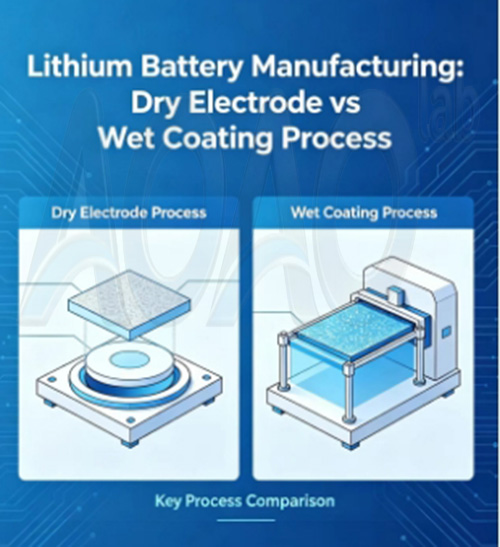
The wet coating process is currently the absolute mainstream solution for Lithium battery production. Similar to kneading dough to make steamed buns in daily life, it mixes active materials, conductive agents, binders and solvents such as NMP into homogeneous slurry. The slurry is then coated onto copper or aluminum foil via coating machines, and finally made into electrode sheets after high-temperature drying in long ovens and calendaring.
- Mature, stable and highly adaptable: Developed over decades, this process boasts a well-established technical system. Mature equipment and process packages are available from lab-scale trials to GWh-level mass production lines, making it a reliable mainstream choice for most power battery manufacturers.
- Growing practical pain points:
1. High costs and massive energy consumption: The drying process accounts for 30%-50% of the total energy consumption in cell production. Supporting NMP solvent recovery equipment comes with high construction costs, further raising production line investment and operational expenses.
2. Limited performance ceiling: Material migration easily occurs during solvent evaporation, resulting in uneven electrode porosity and cracking in thick coating applications, which restricts further improvement of energy density. Residual solvents may also impair battery cycle life.
3. Mounting environmental pressure: Toxic NMP solvents are subject to increasingly stringent environmental regulations on recovery and emission, pushing up compliance costs for medium and small manufacturers continuously.
II. Industry Innovation Breakthrough: Advantages and Challenges of Dry Electrode Technology
Completely solvent-free, the dry electrode technology is analogous to directly pressing raw materials into biscuits. It prepares electrode sheets through electrostatic spraying or roll compaction after dry powder blending, and is regarded as one of the core next-generation lithium battery manufacturing technologies.
- Core advantages addressing industry bottlenecks:
1. Cost and efficiency revolution: It eliminates three high-energy-consuming procedures including coating, drying and solvent recovery. Production line construction costs can be reduced by around 40%, operational costs by 20%, while carbon emissions drop by nearly half, qualifying it as an eco-friendly green process.
2. Breaking performance limits: The solvent-free system enables tighter bonding of active material particles and higher electrode compaction density. It supports ultra-thick electrodes 2 to 3 times thicker than those made via wet processes, lifting energy density by 15%-20% and greatly optimizing fast-charging performance.
3. Superior environmental compliance: No toxic solvents are adopted throughout the process, completely eliminating environmental risks from NMP recovery and discharge, as well as performance hazards caused by solvent residue.
- Existing challenges for large-scale application:
The dry electrode technology still faces high equipment barriers, stringent process control requirements and a long verification cycle for mass production consistency. Extensive engineering verification is still needed in binder formula optimization and electrostatic spraying uniformity control, and large-scale popularization will take time.
III. AOAO Lab’s Viewpoint: Not Replacement, but Phased Adaptation and Collaborative Upgrading
"We do not believe dry electrodes will replace wet processes overnight, just as feature phones still have their niche markets in the smartphone era," said the Technical Director of AOAO Lab. For most manufacturers, the rational approach is to select process routes based on product positioning, production capacity and cost affordability, rather than blind trend-chasing.
- Wet coating remains the optimal mass-production choice at present: For mainstream consumer electronics and mid-to-low-end power battery markets, the mature and stable wet process delivers the best balance between cost and performance. AOAO Lab also keeps launching new-generation slurry mixing equipment with high homogenization efficiency and low energy consumption to help clients optimize the efficiency and consistency of wet processes.
- Dry electrode represents the future of high-value markets: Its strengths stand out rapidly in high-end power batteries, solid-state batteries, energy storage and other segments with high requirements for energy density and environmental protection. AOAO Lab has taken the lead in R&D of supporting dry powder mixing and electrostatic spraying equipment, providing full-chain support for clients from laboratory verification to pilot scale-up.
IV. AOAO Lab Empowers Clients Through the Process Transformation Cycle
Against the rapid technological iteration of the lithium battery industry, AOAO Lab adheres to the customer-oriented R&D philosophy. Instead of hyping up concepts, it delivers customized solutions for clients at different development stages with diverse positioning through solid technical accumulation.
- For clients sticking to wet processes: We provide high-efficiency and low-energy-consumption slurry mixing equipment and coating defect optimization solutions to help them cut costs and boost efficiency on existing production lines.
- Clients deploying dry electrode technologies: We offer dry powder blending process verification and customized pilot production line equipment development, shortening technical validation cycles and lowering trial-and-error costs.
"The ultimate goals of lithium battery manufacturing are always higher safety, greater energy density, eco-friendly production and better cost-effectiveness," AOAO Lab stated. Both wet and dry processes are valuable as long as they help clients achieve these goals. We will continue to delve into material preparation technologies and work with partners to drive the sound upgrading of the global lithium battery industry.
About AOAO Lab
AOAO Lab is a high-tech enterprise focused on the R&D and manufacturing of lithium battery material preparation equipment. Its core products include high-shear dispersers, vacuum mixers, slurry iron removal and filtration devices, and dry powder blending systems. The company provides one-stop solutions ranging from laboratory R&D to mass production support for global lithium battery material and battery manufacturers.
RELATED NEWS
- AOAO Lab Ships Complete Set of Lithium Battery Equipment for Electrochemical Lab 2026-07-27
- Another Set of Electrochemical Laboratory Equipment Packed and Shipped to Custom 2026-07-25
- Xiamen AOAO New Energy Launches New-Generation One-Stop Integrated Lithium Batte 2026-07-19
- Xiamen AOAO New Energy Lab Upgrades Pilot Production Line for Compact Household 2026-07-15
- Faster Delivery! Spot Welders and Battery Capacity Testers Shipped Directly to a 2026-06-22
CATEGORIES
LATEST NEWS
CONTACT US
Contact: Lily Zhao
Phone: 15880250943
E-mail: Lily@aoaolab.com
Whatsapp:8615880250943
Add: No. 208, Binghu Erli Road, Haicang District, Xiamen city, China